Pollensa Mallorca Villas


About Mallorca


Geography

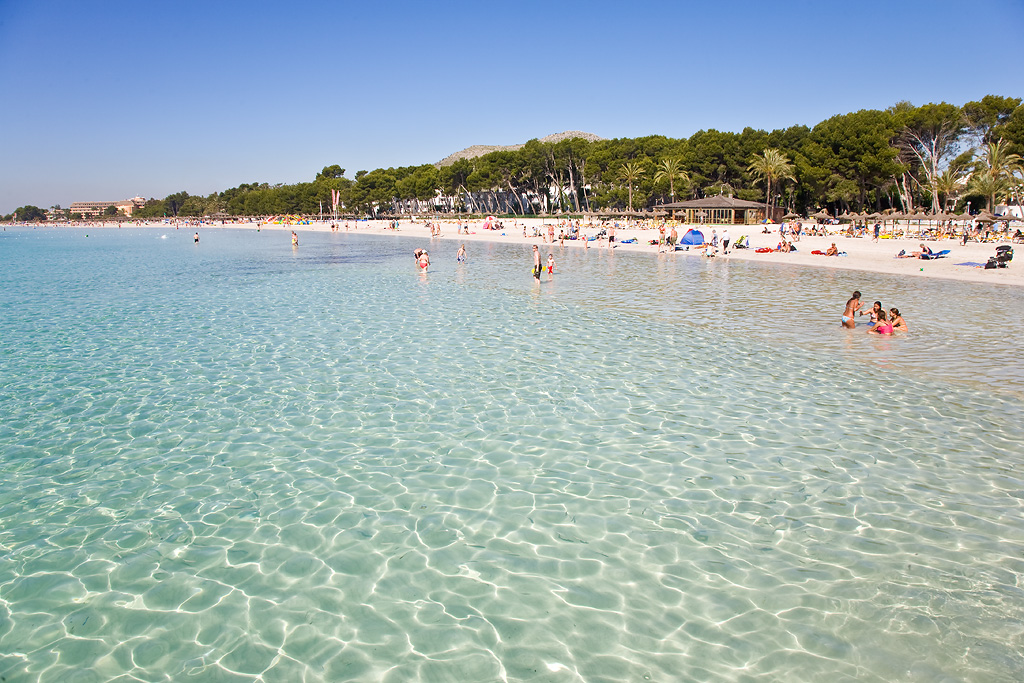
Majorca has two mountainous regions each about 70 km in length. These occupy the north-western (Serra de Tramuntana or Tramuntana range) and eastern thirds of the island. The highest peak on Majorca is Puig Major (1,445 m) in the Serra de Tramuntana. As this is a military zone, the neighbouring peak at Puig de Massanella is the highest accessible peak (1,364 m). The northeast coast comprises two bays: the Badia de Pollença and the larger Badia d'Alcúdia. The northern coast is rugged and has many cliffs. The central zone extending from Palma is generally flat fertile plain known as Es Pla. The island has a variety of caves both above and below sea-level. Two of the caves above sea-level also contain underground lakes and are open to tours. Both are near the eastern coastal town of Porto Cristo, the Cuevas dels Hams and the Cuevas del Drach.

The climate is Mediterranean, with markedly higher precipitation in the Serra de Tramuntana. Summers are hot in the plains and winters mild to cool, getting colder in the Tramuntana range; in this part of the island brief episodes of snow during the winter are not unusual.

There are two small islands off the coast of Majorca: Cabrera (southeast of Palma) and Dragonera (west of Palma).

Cuisine

Ensaïmades

In 2005, there were over 2,400 restaurants on the island of Majorca according to the Majorcan Tourist Board, ranging from small bars to full restaurants. Despite Majorca’s location in the Mediterranean, seafood is often imported. Olives and almonds are typical of the Majorcan diet. The island now has over 4 million almond and olive trees. Among the food items that are Majorcan are sobrassada, arros brut (saffron rice cooked with chicken, pork and vegetables), and the sweet pastry ensaïmada.


About Pollensa

From Wikipedia, the free encyclopedia
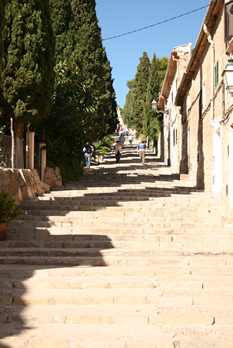

The 365 Calvari steps

Pollença (also spelled Pollensa) is a town and municipality situated in the far north corner of the island of Majorca, near Cap de Formentor and Alcúdia. It lies about 6 km west of its port, Port de Pollença (Puerto Pollensa).

The name "Pollensa" comes from the name of the Roman settlement of "Pollentia," the excavated remains of which lie several kilometers away in the modern municipality of Alcudia. It was founded by the Catalans in the 13th century around 6 km from the coast in an effort to avoid pirate attacks.

Cala Figuera.

Main sights

Most houses were built in the 17th and 18th centuries and many streets are very narrow and compact, a leftover from the medieval era. The central square, called Plaça Major, has numerous outdoor cafés and is dominated by a large 13th century church Esglèsia de Nostra Senyora dels Àngels (Our Lady of the Angels) which was built by the Knights Templar.

One of the town's most distinctive features is the 365-step stairway north of the square; this leads up to a chapel on top of the hill known as Calvary. On Good Friday this is the setting for the most dramatic parade of the year. First, on the road winding up the back of the hill, there is an enactment of the Stations of the Cross. This is followed by a mock crucifixion on top of the hill after which the figure of Christ is ceremonially removed from the Cross. There is a sombre, torchlit parading of the body of Christ through the town it is led by hundreds people in cloaks, masks and pointed hats and done in total silence save for the slow beating of a drum.

The town also has an ancient bridge of Roman design that crosses a torrent to the north of town.

External links



Contact:: 610 37 26 97 info@pollensamallorcavillas.com                                                                           Legal and privacy